

Smart lubricant management – Avoid shortages, reduce costs and CO2 emissions
Year of publication: 2026
What began with the escalation of the Middle East conflict in 2023 has now reached the lubricant shelves – at the latest since the massive military strikes and the blockade of the Strait of Hormuz in early 2026: Geopolitical tensions are severely disrupting the supply of base oils.
The resulting supply bottlenecks and, in some cases, drastic price increases for lubricants are prompting a shift in thinking across all industries. Proactive oil and lubricant monitoring is thus no longer merely a matter of cost efficiency or CO2 savings – it has become a decisive factor in ensuring the operational capability and supply security of machines and systems in industry and manufacturing.

Since spring 2026, high-performance lubricants have become noticeably scarcer. War-related damage to the Pearl-GTL plant in Qatar has severely impacted the supply of API Group III base oils, an indispensable raw material for modern synthetic and high-performance lubricants. South Korean refineries, which secure around 30 percent of global Group III supply, cannot – or will not – close this gap. The production of diesel fuel currently promises significantly higher margins. At the same time, API Group II base oils, which have so far frequently been used as an alternative, are increasingly coming under pressure for the same reasons.
The consequences are clearly felt throughout the entire value chain: rising procurement costs, longer delivery times, and limited availability of lubricants.
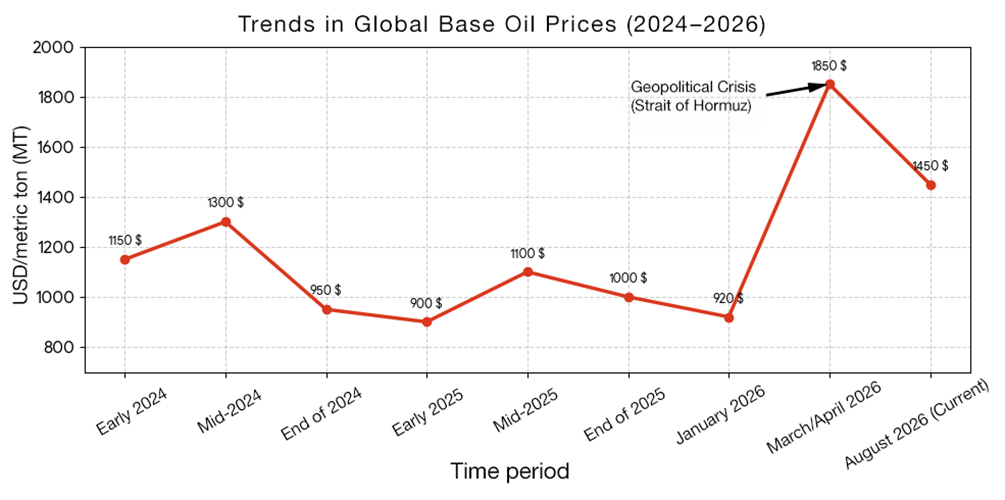
Market figures also confirm this trend: In summer of 2025, base oil prices in Northwestern Europe (FCA basis, U.S. dollars per metric ton) were still around 900 U.S. dollars per metric ton for API Group I base oils. By the end of April 2026, they had risen to over 2,000 U.S. dollars per metric ton. For API Group III base oils, prices even reached around 3,000 U.S. dollars per metric ton in early summer 2026. The sharp price increase began in March 2026 – coinciding with the attack on the Pearl-GTL plant.
The following chart illustrates the approximate trend in global base oil prices (average across Groups I, II, and III in U.S. dollars per metric ton):
Lubricants are machine components
The current supply shortage is not a temporary, isolated phenomenon. It highlights what maintenance professionals have known for a long time: Oils and lubricants are not consumables that are replaced at fixed intervals. Rather, they should be viewed as an integral part of the machine.
Those who continuously monitor the condition of the machinery can make objective, data-driven decisions about whether and when a change is actually necessary. This is precisely where professional lubricant analyses come into play.

More than just oil analyses
A professional analysis considers not only the condition of the lubricant, but always the condition of the machine as well. This is because wear metals, contaminants, additive degradation, or changes in the lubricant’s physical properties provide valuable insights into the technical condition of components and enable the early detection of damage.
OELCHECK is based precisely on this holistic approach. Laboratory results are not evaluated in isolation but are interpreted by experienced tribologists in the context of the machine, its application, and operating conditions. The analysis data yields concrete, practical recommendations for action – ranging from extending oil change intervals and implementing targeted maintenance measures to the early detection of incipient machine damage.
Condition-based maintenance instead of rigid replacement intervals
This holistic approach opens up new possibilities for maintenance personnel when it comes to managing lubricants. Condition-based maintenance replaces oil changes based on fixed operating hours or rigid calendar intervals. An oil change is performed only when the analysis actually indicates it is necessary – or even sooner, if the first signs of incipient damage appear. Lubricant analysis thus serves a dual purpose: it prevents unnecessary oil changes while simultaneously identifying critical developments before they lead to costly machine damage.
The basis for this is a precise picture of the condition of the lubricant and the machine. Which additives are still effective? Has the viscosity changed? Are there signs of oxidation, water ingress, contaminants, or metallic wear as indicators of incipient wear? Only the totality of this information provides a reliable basis for well-informed maintenance decisions.
Why oil change intervals might often be longer
The oil change intervals recommended by machine or lubricant manufacturers are generally conservative. They must take into account a wide variety of operating conditions, loads, and safety margins and therefore cannot reflect the specific condition of an individual machine.
Professional trend analyses provide the necessary transparency here. They document the lubricant’s performance over an extended period and make it possible to adjust oil change intervals reliably and transparently to the actual operating conditions. Modern synthetic oils often have significantly greater performance reserves than rigid change intervals would suggest – provided their condition is continuously monitored and documented.
In many applications, such trend analyses are also a prerequisite for machine or lubricant manufacturers to approve extended oil change intervals. This applies, for example, to wind turbines, commercial vehicles, or industrial production facilities. Without this evidence, the only option is often a precautionary oil change – and thus the waste of valuable resources.
What an oil change really costs
The example of a 3-MW wind turbine illustrates the economic potential of condition-based lubricant management. An oil change in the main gearbox costs approximately € 15,600 – including all direct and indirect costs. This includes about € 10,500 for roughly 1,100 liters of synthetic oil, € 1,500 for the external service technician and € 3,600 in lost production during the turbine shutdown.
In contrast, the costs for regular condition monitoring are as follows: An OELCHECK lubricant analysis for wind turbines costs approximately € 80. Including sample collection by a service technician (approx. € 160), the total cost every 5,000 operating hours is only € 240.
Practical experience shows that, with continuous monitoring, main gearboxes can often be operated significantly longer than the manufacturer’s recommended 30,000 operating hours – in many cases, 60,000 operating hours or more. If the oil change interval is doubled in this way, one complete oil change – valued at € 15,600 – is eliminated. This is offset by only twelve analyses, including sampling, at a total cost of € 2,880.
The savings thus amount to approximately € 12,720 per oil change cycle, while also providing greater operational reliability.
Sustainability starts with an oil change
In addition to cost-effectiveness, the carbon footprint of lubricants is increasingly coming into focus. Over its entire life cycle – from raw material extraction through manufacturing to disposal – one liter of synthetic oil generates an average of about 3.8 kg of CO2*.
Taking a 3-MW wind turbine with an oil volume of 1,100 liters as an example, this means that every oil change avoided saves approximately 4,180 kg of CO2. If the oil change interval is doubled, this corresponds to the annual CO2 sequestration capacity of about 334 trees. If the interval is tripled, this savings figure doubles accordingly.
Anyone who wants to calculate the specific impact of their lubricants on their carbon footprint can use the free OELCHECK CO2 calculator.
Detect damage before it occurs
However, extending oil change intervals is only one side of the coin. Equally important is the ability to detect incipient damage at an early stage. Lubricants continuously convey information directly from a machine’s heavily loaded friction points. Changes in wear metals, viscosity, additives or contaminants often provide valuable clues about critical developments long before a failure occurs.
What matters here is not a single analysis, but rather observing trends over time. Only trend analyses reveal gradual changes and make it possible to plan maintenance measures in a targeted manner before unplanned downtime or costly consequential damage occurs.
Conclusion: Lubricant management is becoming a competitive factor
The tight supply of base oil in 2026 is far more than a temporary market disruption. It makes it clear that lubricants are now a strategic resource – both economically and environmentally.
Companies that consistently monitor the condition of their lubricants avoid unnecessary oil changes, reduce costs and CO2 emissions, and detect incipient machine damage at an early stage. At the same time, they establish the data foundation for informed maintenance decisions and – where necessary – for OEM approvals of extended oil change intervals.
Smart oil and lubricant management today, therefore, no longer means simply using the right lubricant. It means knowing its actual condition and, based on that, making the right decisions at the right time.
Especially in times of scarce resources and increasing demands for cost-effectiveness and sustainability, this approach is becoming a decisive competitive factor.
* The calculation factor of 3.8 consists of 1.22 kg of CO2 for the fresh oil and its production and transport, plus 2.58 kg of CO2 for the disposal and recycling of the used oil.
OELCHECKER Summer 2026 | Page 4-5


