



Smart lubricant management – Avoid shortages, reduce costs and CO2 emissions
Year of publication: 2026
What began with the escalation of the Middle East conflict in 2023 has now reached the lubricant shelves – at the latest since the massive military strikes and the blockade of the Strait of Hormuz in early 2026: Geopolitical tensions are severely disrupting the supply of base oils.
The resulting supply bottlenecks and, in some cases, drastic price increases for lubricants are prompting a shift in thinking across all industries. Proactive oil and lubricant monitoring is thus no longer merely a matter of cost efficiency or CO2 savings – it has become a decisive factor in ensuring the operational capability and supply security of machines and systems in industry and manufacturing.
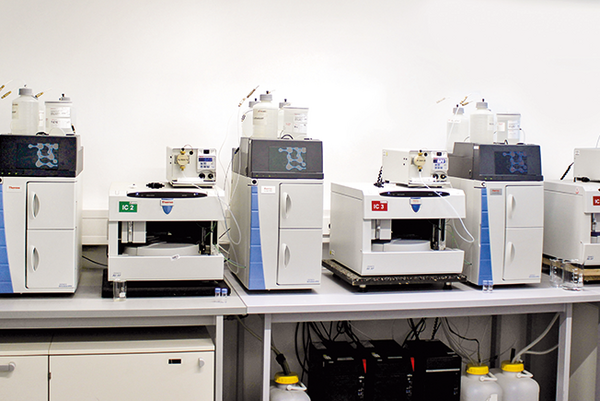
New IC device is now in use! – Increased capacity in coolant analysis
Year of publication: 2026
The coolant analysis department at the OELCHECK laboratory has further expanded its testing capacity: A fourth ion chromatography (IC 4) instrument has been in operation since April 2026.

High-performance microscope for wear and particle analysis
Year of publication: 2026
The OELCHECK laboratory now utilizes a state-of-the-art Keyence microscope that merges two measurement capabilities previously performed by two independent instruments: wear scar analysis from Brugger and VKA tests plus microscopic particle counting.


