


Maintenance and service

As long as a lubricant fulfills its function, it attracts little attention. However, when temperatures rise, filters clog or valves stick, the question quickly arises whether an oil change is necessary – or whether alternative solutions exist. Thousands of liters of turbine oil represent not only a cost factor but also a matter of market availability. OptiOil GmbH from Cloppenburg services industrial oil systems. OELCHECK provides the analytical foundation for its work.
OptiOil, a company of the NEF GROUP, supports industrial enterprises throughout Germany in increasing the availability and service life of turbines, compressors, gearboxes and hydraulic systems, reducing maintenance and operating costs and extending the service intervals of lubricants in use. This is based on comprehensive fluid management. The analysis, maintenance and optimization of lubricants reduce wear and enable early identification of failure risks. The portfolio ranges from lubricant analysis, filtration and drying, through varnish removal, tank cleaning and overhaul support, to online monitoring and CO2 assessment.

This reflects a clear corporate philosophy: “We aim to preserve the lubricant rather than sell it,” as Burkhard vor dem Brocke, Managing Director and founder of OptiOil, succinctly states. Approximately 25 employees form the core team, organized in multiple service units operating nationwide – in power plants as well as in the chemical industry.
The focus is not limited to major aggregates alone. While the turbine is the centerpiece in a power plant, boiler feed water pumps, drives, gearboxes and hydraulic systems operate alongside it – all lubricated with oil. During facility inspections, OptiOil systematically records which lubricant and filter are in use at each location. From this inventory assessment, a machine overview is generated that enables the maintenance manager to determine the condition of his fluids at any time – and also serves as documentation for audits.
A focal point of OptiOil’s work addresses a phenomenon known as varnish, which is unfamiliar to many plant operators. Varnish refers to lacquer-like deposits that originate from undissolved, inherent oil components and primarily accumulate on metallic surfaces within the system. These consist predominantly of polar constituents from the oil itself, which, due to chemical incompatibility or lubricant degradation, no longer remain in solution, precipitate from the oil and ultimately form lacquer-like coatings on machine components. This phenomenon occurs primarily in quiescent zones with low volumetric flow rates or during oil cooling, such as during machine shutdown. In contrast to sludge-like deposits, varnish cannot simply be wiped away with a cloth and is barely removable even with solvents.
The consequences are significant: On valve internal surfaces, the deposits increase friction and cause valves to stick in their seats. In bearings, they elevate temperature and wear rates. A distinction is made between Cold Varnish, which originates from oxidation and Hot Varnish, which is caused by shear stress.
“We have nearly 100 percent of our analyses performed by OELCHECK,” states Justus Kathmann, Managing Director of OptiOil. The analyses provide documented decision-making foundations and enable comparison over extended trend periods. Most importantly, however, they demonstrate which measure is appropriate: filtration when particles compromise cleanliness levels, drying in case of water ingress – or comprehensive oil system cleaning including the tank when deposits have formed.
Three methods are decisive for varnish detection: The RULER test and FTIR spectrum determine the depletion of antioxidants contained in the lubricant. The MPC test identifies the resulting deposit tendency of the oil. OptiOil operates its own measuring equipment and conducts particle measurements and water testing on-site. However, the laboratory report from OELCHECK with its more than 40 individual parameters serves another purpose as well: “With this, I have something that the customer can incorporate into his machine history as documentation,” vor dem Brocke explains the distinction between rapid testing and reliable findings from the OELCHECK laboratory.
Kathmann emphasizes an additional advantage: Since the company serves customers throughout Germany, OptiOil relies on OELCHECK analysis packages as an efficient supplement to its service offerings. This enables samples to be collected on schedule and immediately integrated into condition monitoring. OptiOil assumes responsibility for professional evaluation of the analysis data and accompanies the customer through all subsequent steps. In this manner, continuous monitoring of lubricants and systems is ensured at all times.
Two practical examples demonstrate the working procedure:
Case study 1: deposits in the turbocompressor
At an operator of air separation plants, anomalies accumulated in an air turbo-compressor with approximately 5,000 liters tank capacity: The oil temperature in the return line rose to over 70 °C, bearing temperature increased correspondingly, vibrations occurred in the high-pressure section and gearbox – until the compressor switched to emergency operation. Inspection revealed severe deposits on gear pinions and plain bearings.
The causal chain could be reconstructed: Insufficient cooling capacity allowed oil temperature to rise, thermal stress accelerated aging and the resulting deposits coated the gears with varnish – whose buildup in turn caused the vibrations.
The OELCHECK analysis confirmed this causal chain: Antioxidants were severely depleted, the oil showed signs of rapid progressive aging and the slightly elevated MPC value indicated increased deposit tendency. A simple oil change would therefore be insufficient – the system itself required cleaning prior to refilling.
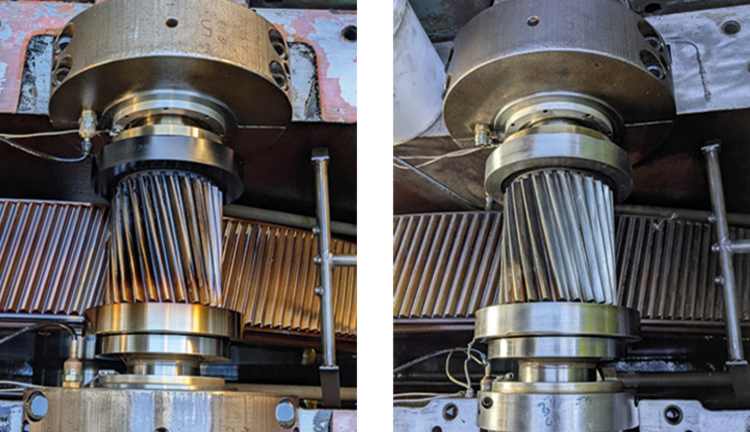
Prior to the oil change, OptiOil deployed the solvency improver DECON™ from partner Fluitec and supplemented the treatment with a varnish removal filter. The benefits became apparent in multiple ways: Production continued during the pre-cleaning phase, the customary system flushing with flush oil was eliminated, downtime was reduced and mechanical cleaning of components became unnecessary. Before filling the new lubricant, the system was optimally clean – the prerequisite for extended service intervals.
Case study 2: recovery of a turbine oil charge
The second case illustrates the procedure for sustainable regeneration of turbine oil. Prior to a scheduled turbine overhaul, analysis of an approximately 7,000-liter oil charge revealed reduced antioxidant content, an elevated MPC value and altered foam behavior. The remaining parameters were within normal range – sufficient reason to evaluate oil regeneration as an alternative to oil change.
Analytics accompanied the entire process: Laboratory analyses from OELCHECK and on-site measurements documented the condition before, during and after treatment. DECON™ AO, a solvency improver that supplies additional antioxidants to the oil, was deployed. The addition was monitored via online analysis. In parallel, varnish filtration removed dissolved aging products from the circulation.
The results of the laboratory analyses confirmed the approach: Oxidation protection was restored, the cleanliness class achieved the specification-compliant value, the MPC value decreased to normal level. All relevant parameters of the final examination again corresponded to the required standard.
The oil charge remained in the system – eliminating the otherwise necessary flushing, new procurement and waste oil disposal. Regeneration cost only half as much as a complete oil change and OptiOil quantifies the CO2 savings compared to new filling at approximately 80 percent.
What began in both cases as technical and economic optimization has meanwhile acquired an additional dimension: The supply situation for lubricants is generally constrained. Vor dem Brocke reports on turbine oils that are difficult to procure despite conventional formulation and on inquiry volumes not seen in previous years. For operators of critical systems, continued use has thus gained new significance: It is no longer solely a matter of economic viability but also serves operational planning security and uninterrupted long-term system operation.
Here the circle closes to analytics. Those who understand the condition of their lubricant can reliably extend service intervals rather than estimate them. The assessment by OELCHECK tribologists transforms measurement data into a decision-making foundation and converts an oil charge that would have been changed previously into a resource that remains in the system.
Headquartered in Cloppenburg, OptiOil supports industrial enterprises throughout Germany in sustainably improving the performance and availability of their machinery and systems. The foundation is comprehensive fluid management: analysis, maintenance and optimization of lubricants and operating fluids.
With the OptiOil®SAVE approach, the company pursues the objective of utilizing existing resources optimally and extending their service life. As a company of the NEF GROUP, OptiOil is part of a network specializing in CO2-optimized solutions and sustainable value creation.
related links
OELCHECKER Summer 2026 | Page 8-9